Technical White Paper: Navigating China’s Commercial Energy Storage Manufacturing Ecosystem
The global shift toward decentralized grid infrastructure and aggressive peak-demand tariffs has transformed commercial and industrial (C&I) energy storage systems (BESS) from discretionary backup assets into mission-critical balance sheet stabilizers. For institutional procurement directors, engineering, procurement, and construction (EPC) firms, and regional project developers, identifying the best commercial energy storage manufacturers in China requires far more than comparing ex-factory equipment price tags. It requires a rigorous technical evaluation of electrochemistry stability, battery management system (BMS) logic, multi-tier protection architectures, and power conversion system (PCS) interoperability.
Executive Sourcing Principle: Tier-1 procurement success is governed by the total levelized cost of storage (LCOS). Minimizing commissioning overhead and thermal downtime requires specifying cell-to-pack (CTP) integration density, rigorous testing under UL 9540A fire propagation protocols, and native CAN/RS485 handshake compatibility across hybrid inverters.
1. Electrochemistry Dynamics: The Superiority of Prismatic Lithium Iron Phosphate (LiFePO4)
Modern commercial energy storage demands safe operation, long operational life, and cyclic stability under continuous, rapid charge-discharge profiles. Nickel Manganese Cobalt (NMC) chemistries possess higher volumetric energy density, yet the global commercial sector has standardized almost universally on Lithium Iron Phosphate (LiFePO4 or LFP). This pivot is driven by intrinsic thermal runaway thresholds: LFP resists structural degradation and self-sustaining thermal events up to 270°C, contrasting sharply with the 150°C to 210°C breakdown threshold observed in NMC cells.
China's leading manufacturing clusters in Anhui, Jiangsu, and Guangdong utilize automated manufacturing execution systems (MES) to build LFP prismatic cells using advanced wet chemical coating and roll-to-roll automated stacking. Unlike cylindrical cells that demand thousands of laser-welded busbar interconnects—creating numerous potential micro-crack and electrical failure points—heavy-duty 280Ah and 314Ah prismatic LFP cells optimize commercial systems by reducing internal connection complexity. This yields internal cell impedance below 0.25mΩ, limits localized heat generation during continuous 0.5C to 1C cycling, and extends asset operating lifetimes past 6,000 to 8,000 cycles at 80% Depth of Discharge (DoD) and 25°C ambient conditions.
2. Architecture Integration: Low-Voltage (48V/51.2V) vs. High-Voltage (HV) Multi-Cabinet Topology
Engineering commercial energy storage installations mandates selecting between low-voltage (LV) parallel configurations and high-voltage (HV) series string configurations based on project power requirements:
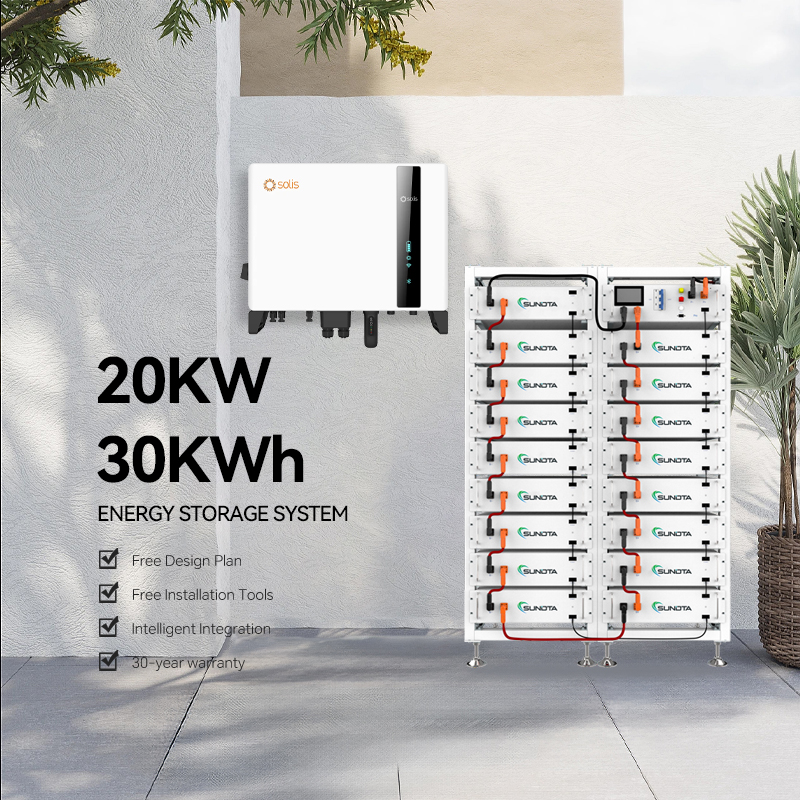
Low-Voltage (51.2V nominal): Best suited for light commercial loads and smaller off-grid setups ranging from 10kW to 30kW. While 51.2V systems provide intrinsic safety during maintenance and simplify battery module expansion, distributing substantial current at low voltages introduces higher line transmission resistance, requiring heavier copper cabling and larger conduit runs.
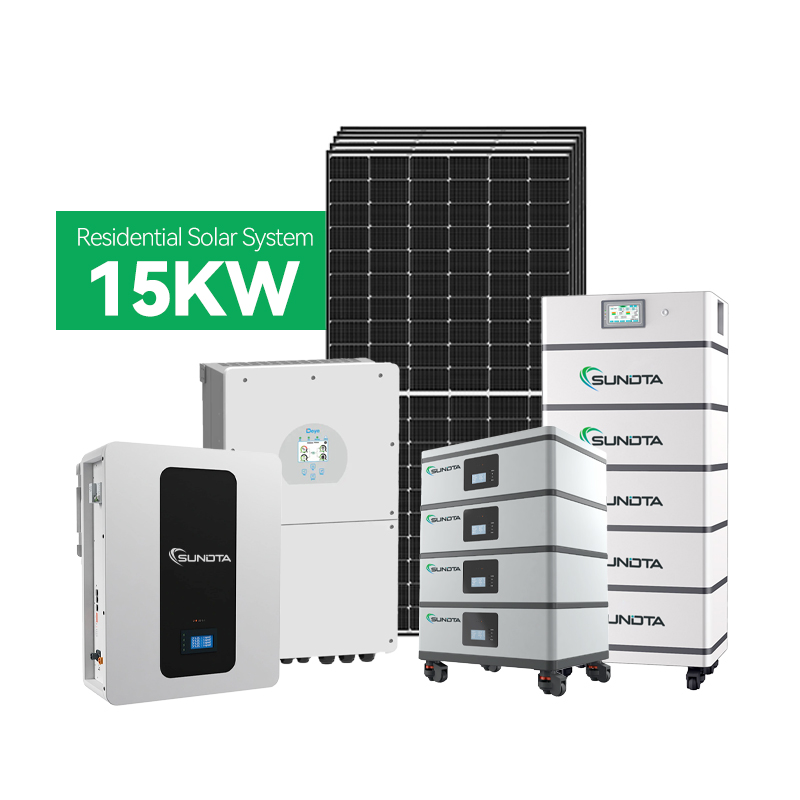
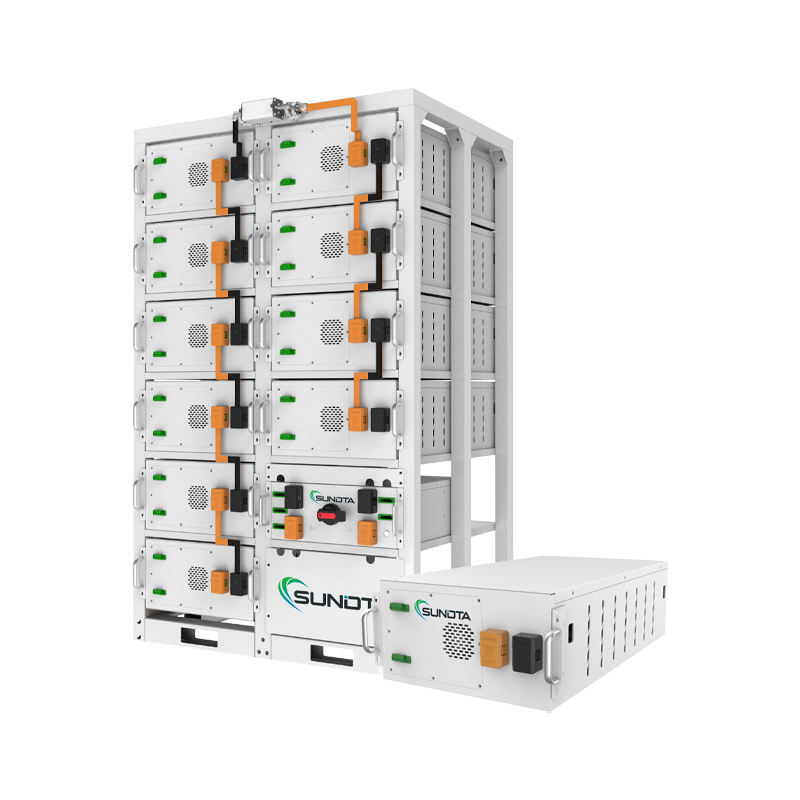
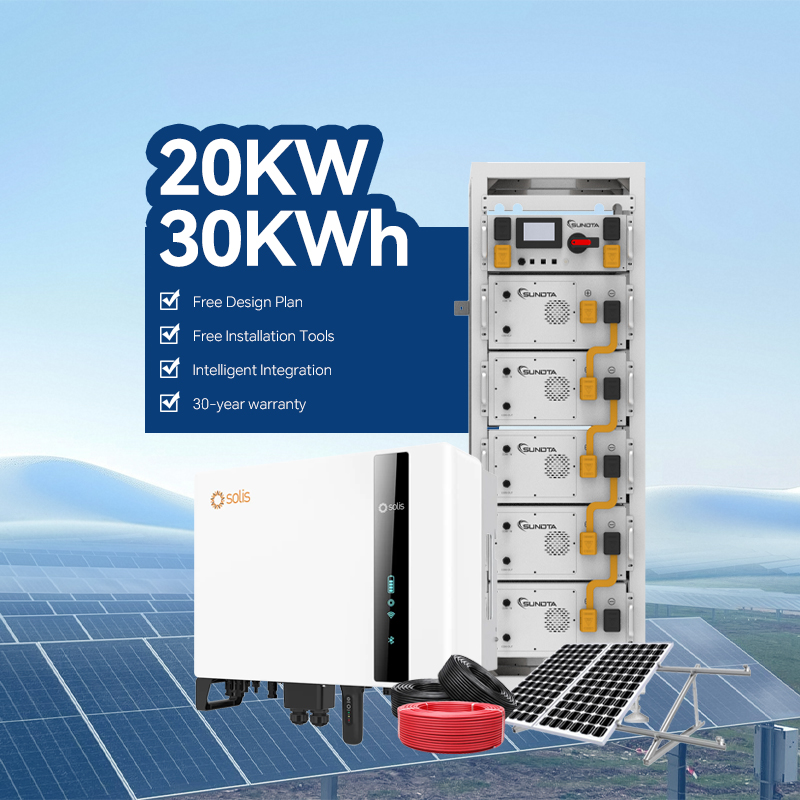
High-Voltage Topologies (200V to 1000V+ DC): The benchmark standard for large-scale C&I facilities, multi-tenant industrial real estate, and utility-feeder support. Operating at voltages up to 1000V DC lowers string operational current, reducing internal $I^2R$ thermal dissipation losses and cable cross-sectional area requirements. More critically, high-voltage battery architecture connects directly to transformerless 3-phase hybrid inverters (e.g., Deye, Solis), boosting round-trip round-trip efficiency (RTE) from 89% up to 95.5%.
3. Battery Management Systems (BMS) and Energy Management Systems (EMS) Architecture
A lithium pack is only as reliable as its active management system. Tier-1 Chinese manufacturers utilize a three-tiered hierarchical BMS network:
- Tier 1: Slave BMS (BMU): Direct on-cell instrumentation acquiring real-time differential voltages (±2mV accuracy) and surface temperatures via multiple NTC thermistors across every cell group.
- Tier 2: Master BMS (BCU): Rack-level computational units performing real-time State-of-Charge (SoC) algorithms via extended Kalman filtering, managing active/passive cell balancing, and directing high-speed contactors.
- Tier 3: System Energy Management System (EMS): Microgrid brain running SCADA telemetry, interfacing via IEC 61850 or Modbus TCP/IP, and deploying algorithmic power-dispatch scripts for time-of-use (TOU) arbitrage, reactive power compensation, and dynamic peak shaving.
High-Capacity 314Ah+ Cells
The standard 280Ah cell footprint is shifting rapidly to 314Ah and 320Ah form factors. This transition drives containerized volumetric density from 3.35MWh to over 5MWh per 20ft ISO container enclosure, lowering project civil engineering and balance-of-system (BOS) capital expense by up to 14%.
Liquid-Cooled Thermal Architecture
Traditional forced-air cooling creates temperature gradients exceeding 5°C across large racks, accelerating uneven cell degradation. Closed-circuit liquid-cooling cooling plates keep internal thermal differentials below 2.5°C, reducing cooling parasitic energy consumption by 30% and extending system operational life.
Stringent Multi-Layer Safety Regimes
Future global procurement requires strict alignment with UL 9540, UL 9540A, NFPA 855, and IEC 62619 standards. Modern OEM battery containers now feature built-in combustible gas detection (H2/CO), multi-stage aerosol or FM200 suppression systems, and integrated deflagration relief panels.
2GW Automated Manufacturing
Advanced robotic assembly lines deliver consistent manufacturing tolerances, complete EL inspection testing, and full trace serialization across all modules and integrated systems.
Pre-Tested Inverter Matching
Every LiFePO4 battery rack is pre-commissioned and firmware-validated with Deye, Solis, and Growatt inverters at the factory, eliminating communication errors on-site.
TÜV Rheinland Certified
Operations verified on-site by TÜV Rheinland. Systems ship with full documentation, including CE declarations, UN38.3 test summaries, and factory flash test reports.
Global Freight & OEM Sizing
Supported Incoterms include FOB, CFR, CIF, and EXW with tailored OEM/ODM options: from custom battery pack enclosures to complete utility-scale BESS container builds.